One proverb a day, with its original, how it is said, what it means, and the history behind it where there is history.
Every line is traced to a printed page, and the card shows you that page.
Each day it is one saying from one people, in their own words. You read it, you learn something true, and it is finished.
How this card was made
Everything on a card is either taken from a printed source, and says which, or written by us, and says so.
This is the standard for every card. What comes from a book names the book, down to the page. What we wrote is marked as ours. Where the source is silent, the card says it is silent rather than filling the gap without telling you.
From the sources
- The saying, in Hungarian
- Erdélyi János, Válogatott magyar közmondások, Pest, 1862, page 151, entry 4247.
- Where Erdélyi found it
- He marks it “Sz.”, for Szirmay, 1804. He was reprinting it, not taking it down himself. Nobody has traced it earlier.
- The map
- Matthias Zündt, Nova totius Ungariae, Nuremberg, 1567. Library of Congress, World Digital Library.
Ours
- The English line, and how to say it
- Erdélyi printed the Hungarian only.
- What it means, and when it is said
- Erdélyi gives no note on its use. The reading is ours, from how the saying is used now, and the card says so.
- The black soup, and where the saying may come from
- The story of 1541 is told with the saying everywhere. Hungarian scholars doubt it, and the card says that too.
- The siege, the word-by-word gloss, the observation
- Written by us, from the history.
- What is not settled
- Where the saying really comes from. The card asks, and names what would answer it.
The whole sheet
Hungary, engraved by Matthias Zündt in Nuremberg in 1567, while the Turks held Buda. It opens on Buda, as the card does. Drag to move around it; zoom with the buttons or by pinching.
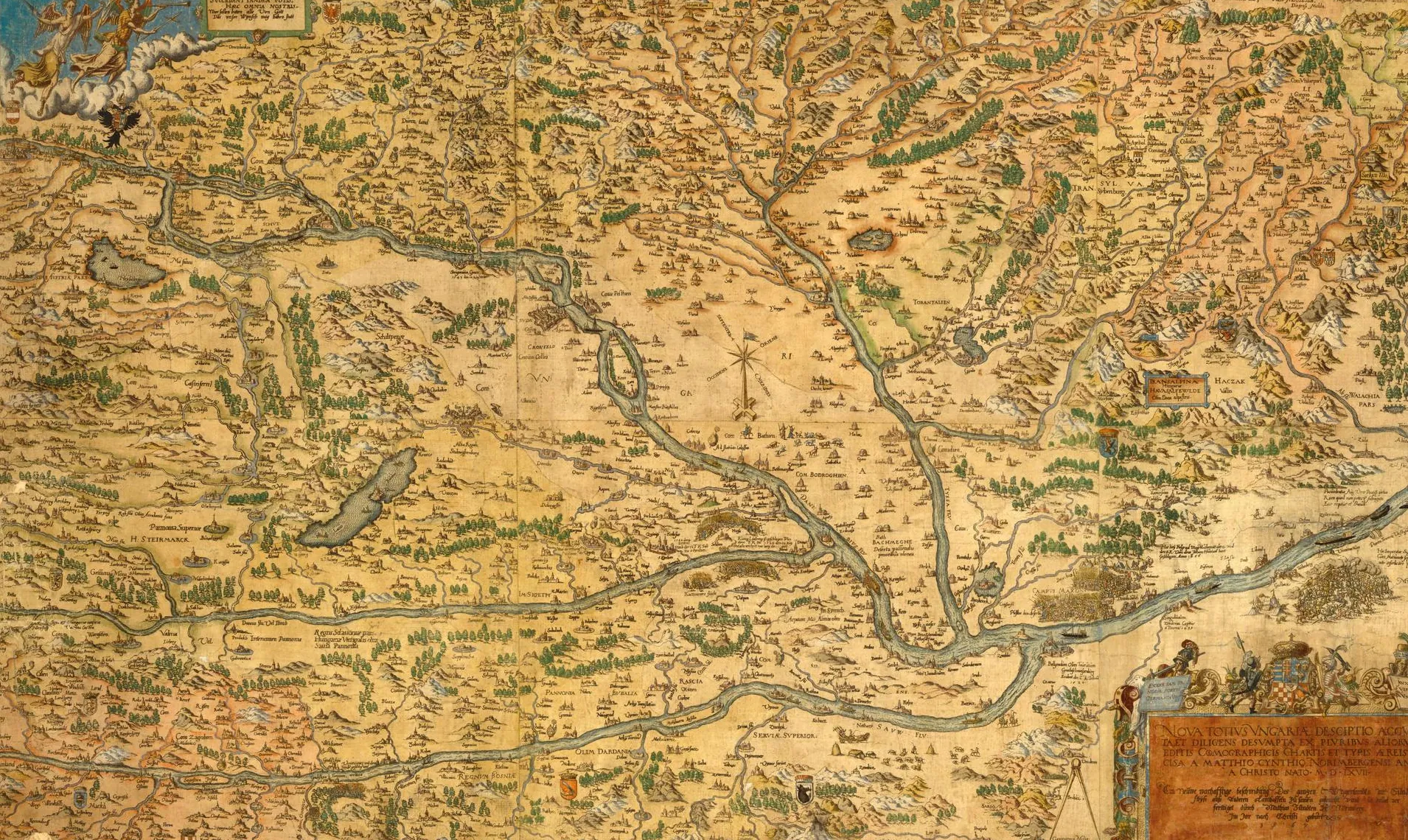
Library of Congress, World Digital Library
Nothing is trying to keep you.